I recently bought a smart security camera that claimed to use advanced artificial intelligence to recognize my face, my cat, and package deliveries. One afternoon, a stray raccoon waddled onto my porch, stole a bag of chips, and looked directly into the lens. Instead of instantly alerting me, the camera froze. It had to compress the high-definition video, upload it across the universe to a cloud server, wait for a giant computer farm to figure out what a raccoon was, and then send a notification back to my phone. By the time my phone chirped saying “Animal Detected,” the raccoon had already finished the chips, taken a nap, and moved on with his life. I realized right then that sending every single byte of data to the cloud just to make a simple decision is a completely ridiculous way to use technology.
The Core Confusion:
To really understand why the technology world is shifting on its axis right now, we have to pull apart the terms. Most people hear “Artificial Intelligence,” and they think of giant supercomputers sitting in secret underground bunkers, consuming enough electricity to power a small city. That is only half of the story.
In the AI world, there are two completely different stages: Training and Inference.
Think of AI Training like going to medical school. To create a smart AI model, engineers have to feed it millions of examples. If you want an AI to recognize a bicycle, you have to show it five million pictures of bicycles, unicycles, rusty mountain bikes, and tricycles. This process takes weeks, requires thousands of massive computer chips working together, and uses a mind-boggling amount of energy. This stage absolutely must happen in the giant cloud data centers because a normal laptop or smartphone would literally catch fire trying to do it.
Now, think of AI Inference like a doctor actually treating a patient after graduating from school. Inference is when a completed, fully trained AI model takes a look at a brand-new piece of data, like a photo you just took with your phone, and makes a snap decision. It uses its past education to say, “Ah, yes, that object right there is a bicycle.”
For the past ten years, both the training and the inference have happened in the cloud. Your local device was just a dumb screen that captured data, sent it away, and waited for an answer.
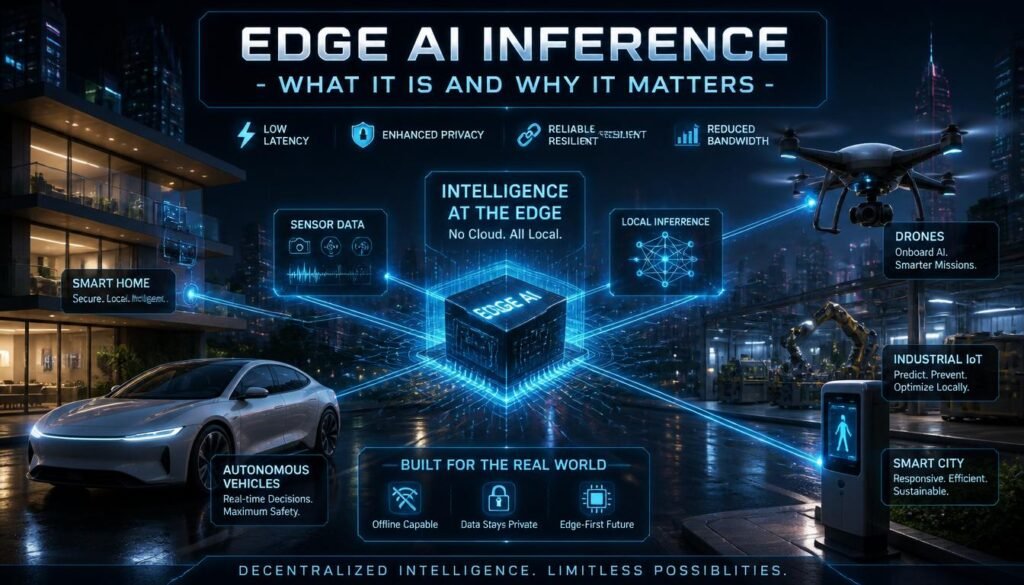
Edge AI Inference means we are taking that educated AI brain, shrinking it down using clever software tricks, and placing it directly onto the “Edge” of the network. The edge simply means the physical device closest to you. It is your smartphone, your smart watch, your smart refrigerator, your car, or a tiny microchip hidden inside an industrial factory machine.
By running the AI directly on the device in your hand, the machine can think, see, hear, and make decisions instantly, without needing a single drop of internet connection. It is the difference between having a translator living inside your pocket and having to make an international phone call every time you want to say “hello” in a foreign country.
The Journey of Data: Cloud Architecture vs. Edge Architecture:
To see the massive difference this technology makes, let us follow the physical journey of a single piece of data under both systems.
Imagine you are driving a modern car equipped with automatic emergency braking. A pedestrian suddenly steps off the sidewalk right in front of your bumper. The car’s front-facing camera takes a picture of the road ahead.
The Old Cloud AI Journey:
If your car relies on the traditional cloud model, here is what must happen in the blink of an eye:
- The camera captures the raw image data.
- The car’s internal computer compresses the file and sends it to the cellular antenna.
- The antenna broadcasts a wireless signal to the nearest cell tower.
- The cell tower routes the data through miles of fiber-optic cables to a regional data center.
- The data center processes the image through an AI model to confirm it is a human being.
- The server sends a command packet all the way back down the fiber-optic line, up the cell tower, and into your car’s antenna.
- The car receives the command and slams on the brakes.
If your cell signal drops to two bars, or if the cloud server is experiencing a heavy traffic spike, this entire loop can take two or three seconds. In a car traveling at fifty miles per hour, two seconds is the difference between a safe stop and a horrible tragedy.
The New Edge AI Journey:
Now, let us look at how that exact same situation plays out when your vehicle is equipped with an independent Edge AI chip:
- The camera captures the raw image data.
- The data travels through a short copper wire directly into a dedicated AI processor sitting inside your car’s dashboard.
- The local processor analyzes the pixels instantly and detects the human being.
- The chip sends an immediate electrical trigger to the braking system.
This entire local loop takes less than 5 milliseconds. The car had already stopped safely before the cloud model could even finish uploading the initial image file to the cell tower.
| Metric | Cloud AI Architecture | Edge AI Architecture |
| Processing Location | Distant data centers and server farms. | Local silicon chips inside your device. |
| Internet Requirement | Must have a fast, continuous connection. | Works completely offline in the wilderness. |
| Response Time (Latency) | Slow and unpredictable (100ms to several seconds). | Hyper-fast and guaranteed (under 5 milliseconds). |
| Data Privacy | High risk; personal data is sent over the air. | Low risk; personal data never leaves the device. |
| Operating Costs | High monthly server bills for data transfers. | One-time cost to buy the physical chip. |
The Four Mighty Reasons Why Edge AI Matters:
When I first started studying this space, I figured Edge AI was just a neat upgrade for speed. But as I built more systems and watched how humans interact with technology, I realized that Edge AI is a fundamental requirement for the future of our digital society. It solves four massive, systemic problems that the cloud simply cannot fix.
1. The Speed Demon:
In the world of computing, delay is called latency. For some tasks, like waiting for a web page to load or downloading a song, a little bit of latency is just a mild annoyance. But for modern applications, latency is an absolute dealbreaker.
Think about a surgeon performing a delicate robotic operation from a computer console, or a drone flying through a dense forest at high speeds, or an industrial robotic arm grabbing heavy metal parts off a moving assembly line. These machines require real-time feedback loops. They cannot afford to wait for a network round-trip. Edge AI drops latency down to near-zero levels, allowing machines to react to the physical world at the exact same speed as human reflexes.
2. The Privacy Vault:
Let us be completely honest with ourselves: we are living through a massive privacy crisis. Traditional cloud apps require you to upload your most intimate data to servers owned by giant corporate entities. Every time you use a cloud voice assistant, your voice recordings are saved in the cloud. Every time you use a smart home camera, video feeds of your living room, your kids, and your daily habits are transmitted over the public internet.
Edge AI turns your physical device into an impenetrable privacy vault. If you have a smart home system powered by Edge AI, the voice recognition and face detection happen entirely on the local microchip.
The device does not need to send your voice recordings or video streams to the internet to understand them. The raw data stays locked inside the physical silicon chips inside your house. If a hacker breaches the central servers of the tech company, they find absolutely nothing because your data was never sent there in the first place.
3. Unbreakable Reliability:
The cloud is incredibly fragile. A backhoe accidentally cutting a fiber-optic cable in Virginia or a power surge at a server farm in Europe can instantly blind millions of smart devices across the planet.
I once stayed in a remote mountain cabin during a winter storm. The power stayed on, but the main internet line went down. Because the cabin’s smart thermostat relied entirely on cloud AI to manage the heating schedule, the thermostat simply stopped working. It couldn’t figure out how to adjust the temperature because it couldn’t talk to its server in California. I was freezing in a room with a perfectly functional heating unit because the software was poorly designed.
An Edge AI device is completely self-sufficient. It doesn’t care if a solar flare disrupts the global satellite network, or if your local internet service provider goes out of business, or if you are sitting deep inside a concrete basement three stories underground. The intelligence is baked directly into the physical hardware. It will keep running its smart algorithms perfectly under any conditions, ensuring your critical systems never experience an unexpected digital blackout.
4. Bandwidth Salvation:
We are generating data at a rate that the physical infrastructure of the internet can barely handle. Think about a modern smart city equipped with ten thousand high-definition traffic cameras. If every single one of those cameras streams constant 4K video footage up to the cloud 24 hours a day, the local network lines will quickly choke and collapse under the weight of the data traffic.
Edge AI acts like a brilliant filter at the very source of the information. Instead of streaming thousands of hours of empty, boring video of an empty street up to the cloud, an Edge AI chip inside the camera sits quietly and processes the video locally. It uses zero network bandwidth while the road is empty.
The moment it detects an accident, a broken traffic light, or a stalled vehicle, it fires off a tiny text alert to the city management grid. You get all the intelligence of a fully monitored camera system while reducing your network bandwidth consumption by over 99 percent.
Squeezing Giant Brains into Microscopic Silicon:
When you look at a cutting-edge AI model like the ones running modern text generators or image creators, the files are absolutely enormous. They take up hundreds of gigabytes of space and require massive amounts of computer memory just to open.
How on earth do we take a digital brain that big and squeeze it into a tiny microchip inside a smartphone or a smart watch without draining the battery in five minutes? This is where the true engineering genius of Edge AI comes into play. Developers use three main mathematical magic tricks to shrink these models down without losing their accuracy.
Trick 1: Quantization (Ditching the Decimals):
When an AI model is trained in the cloud, it uses highly precise, complex numbers to make its calculations. It uses numbers with long decimal strings like 3.14159265. Calculating numbers that precise requires a huge amount of processing power and large memory buckets.
Quantization is the process of rounding these complex numbers down to simple, whole integers. The software engineers tell the AI brain, “Look, you don’t need to calculate down to the millionth decimal place to tell the difference between a dog and a cat. Let’s just round that number down to a simple 3.”
By converting the model’s internal math from heavy decimal numbers to lightweight whole numbers, the file size shrinks by eighty percent, and the chip can execute the math calculations ten times faster while using a fraction of the electricity.
Trick 2: Pruning (Cutting Away the Dead Wood):
During the heavy training phase in the cloud, an AI model builds billions of internal connections, creating a dense web of digital neurons. But once the school phase is over and the AI is fully educated, a lot of those connections turn out to be completely useless. They are just taking up space and doing nothing.
Pruning is like giving the AI brain a radical haircut. Engineers run test data through the model and see which digital pathways are actually being used. If a certain cluster of neurons hasn’t fired a single time after looking at ten thousand images, the pruning software completely snips those connections out of the code.
It gets rid of all the dead weight, leaving behind a lean, muscular, hyper-focused AI model that only contains the essential pathways needed to do its specific job.
Trick 3: Knowledge Distillation (The Teacher and Student Method):
This is my absolute favorite optimization strategy. Imagine you have a massive, omniscient AI model running on a thousand servers in the cloud. We call this the “Teacher Model.”
Instead of trying to shrink the teacher down, engineers build a tiny, empty AI model on a laptop, which we call the “Student Model.” They then set up a system where the student watches exactly how the teacher thinks. The teacher processes a million data points, and the student mimics the teacher’s final conclusions, learning the shortcuts and core philosophies without needing to learn all the raw underlying data that the teacher had to digest.
Through this beautiful digital apprenticeship, the tiny student model achieves ninety-five percent of the teacher’s intelligence while requiring a tiny fraction of the physical hardware space.
Meet the Dedicated Hardware: What is an NPU?
For decades, computers relied on two main chips to handle everything: the Central Processing Unit (CPU) and the Graphics Processing Unit (GPU).
The CPU is the master manager of the computer. It is built to handle a massive variety of different tasks one after the other, like running your web browser, opening an Excel sheet, and playing audio files. It is smart, but it can only do a few things at once.
The GPU was originally built to render beautiful 3D graphics for video games. It features an assembly line of thousands of simple processors working side by side, making it fantastic at doing massive amounts of simple math simultaneously. Because AI math looks a lot like video game math, developers spent years using GPUs to run their AI models.
But as AI became the dominant force in modern technology, chip designers realized we needed a new tool built specifically for this unique task. Enter the NPU, which stands for Neural Processing Unit.
An NPU is a dedicated piece of silicon designed from the ground up to do only one thing: accelerate the unique mathematical formulas used by neural networks. It doesn’t know how to boot up an operating system, and it cannot render a 3D video game. But it can execute billions of AI inference calculations in a single millisecond while sipping less battery power than an old incandescent holiday lightbulb.
When you look at modern smartphone processors, a massive chunk of the physical space on the chip is now dedicated entirely to the NPU. It sits there quietly, waiting for you to unlock your phone with your face, apply an AI filter to a photograph, or use live voice translation during a phone call. Because the NPU handles these tasks locally, your main CPU can stay cool and relaxed, preserving your phone’s battery life so your device can easily last through the entire day on a single charge.
Real-World Industries Being Transformed by Edge AI:
Edge AI Inference is not some distant, sci-fi concept that will arrive in a decade. It is actively reshaping major global industries right now, changing how humans work, stay healthy, and interact with the physical world.
Modern Healthcare: The Smart Wearable Lifesaver:
In the world of medical technology, a few minutes can mean the difference between life and death. Imagine a patient suffering from a rare heart condition who wears a continuous electrocardiogram (ECG) monitor under their shirt.
- The Cloud Model Pitfall: The wearable device captures heart rhythm data and attempts to stream it to a cloud server for analysis. If the patient walks into a deep grocery store basement or takes a flight on an airplane without Wi-Fi, the system is completely blinded. If their heart suffers an irregular event, the cloud cannot see it to send a warning.
- The Edge AI Upgrade: The wearable monitor features a tiny, ultra-low-power NPU running an embedded cardiac AI model. The chip analyzes every single heartbeat locally on the patient’s skin. The moment it detects a dangerous anomaly, the device vibrates against their chest, sounds an audible alarm, and triggers an emergency alert directly through their phone, giving the user those critical extra minutes to sit down, take medication, or call for help before a medical emergency occurs.
Smart Industrial Automation: Pre-Detecting Mechanical Failure:
Modern manufacturing facilities run on massive, complex assembly line machines that operate continuously. If a single bearing or gear inside a multi-million-dollar machine breaks unexpectedly, the entire factory floor grinds to a halt, costing the business hundreds of thousands of dollars per hour in lost productivity.
By attaching tiny vibration and sound sensors powered by Edge AI to these machines, factory managers can listen to the health of their equipment in real time. The local AI chip learns the exact, normal acoustic profile of a perfectly healthy machine.
If a microscopic internal gear develops a tiny crack that is completely invisible to the human eye, the vibration sound will change by a fraction of a percent. The Edge AI chip detects this tiny acoustic shift instantly, alerts the engineering team, and schedules a quick maintenance break during the weekend before the machine suffers a catastrophic breakdown on a busy workday.
Precision Agriculture: Smart Drones and Weed Management:
Farming is an industry that relies heavily on razor-thin profit margins and massive physical scales. To protect crops from weeds and pests, traditional farming practices involve spraying entire fields with millions of gallons of chemical pesticides from airplanes or giant tractors. This is incredibly expensive, wastes chemical resources, and can damage the surrounding environment.
Modern agricultural drones equipped with Edge AI cameras are changing the entire playbook. As the drone flies at high speeds across a massive cornfield, the local AI chip analyzes the video frames instantly, identifying individual weed species hidden among thousands of healthy crop leaves.
Instead of blanketing the entire field in chemicals, the drone uses a precision micro-nozzle to shoot a single drop of pesticide directly onto that exact weed leaf while flying past. The drone can treat a massive farm using 95 percent less chemical volume, saving the farmer a fortune while protecting the health of our global soil and water systems.
The Future of Distributed Intelligence:
As we look toward the next generation of technology, the ultimate goal of the engineering community is to create a seamless matrix of distributed intelligence. We are moving away from the old model of central, corporate cloud overlords and toward an open ecosystem where every object around us possesses its own independent spark of localized intelligence.
Your home will not just be connected to a smart network; it will contain separate Edge AI nodes inside the windows, the doors, the lighting fixtures, and the appliances, allowing your environment to adapt to your presence, optimize its energy consumption, and protect your privacy without ever needing to report your habits back to a corporate database.
By keeping data close to the source, maximizing processing speeds, and building resilient systems that run completely independent of network connections, Edge AI Inference is paving the way for a digital world that is faster, safer, more reliable, and fundamentally more human.
FAQs:
1. Does a device need a continuous internet connection to run Edge AI software?
No, once the optimized AI model is saved into the local chip memory, it can make decisions completely offline.
2. Will running Edge AI models drain my smartphone battery much faster than normal?
No, because modern phones feature dedicated NPUs that are highly optimized to process AI calculations using very little power.
3. Can an existing old device be upgraded to use Edge AI through a software update?
It can run simple models via software, but to get true benefits, the device needs physical NPU hardware built inside.
4. Is Edge AI safer from cyber-attacks compared to traditional cloud-based AI networks?
Yes, because your private data stays locked inside your physical device rather than traveling across the vulnerable public internet.
5. What happens if an Edge AI model makes a mistake or gives an incorrect answer?
It behaves just like cloud AI, which is why developers continue to refine and update the models over time.
6. Can Edge AI chips process high-definition video files smoothly in real time?
Yes, modern NPUs are specifically designed to analyze high-speed video frames instantly for tasks like self-driving safety systems.
