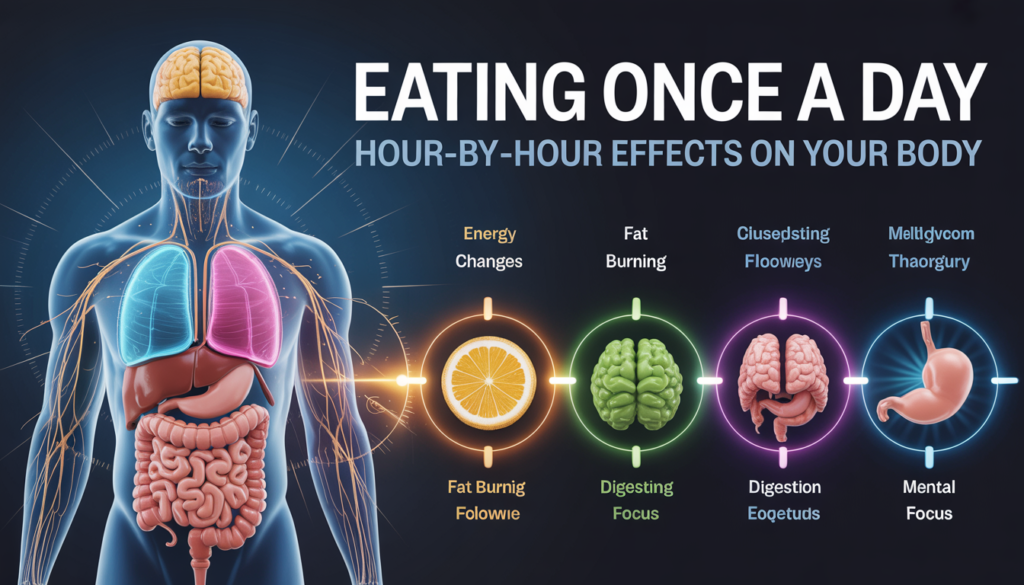
When you compress your eating into a single focused window, a protocol often called OMAD or one meal a day, you aren’t starving. You are flipping a switch that most modern humans have never touched. Imagine a warehouse where delivery trucks never stop arriving. The manager is screaming, boxes are piling up, blocking the exits, and the roof is leaking because no one has time to fix it. This isn’t just a metaphor. This is your body on three meals a day. Now imagine what happens when you finally lock the doors and stop the trucks. For the first time in years, the cleaning crew comes out.
Today, we are looking strictly at the physiology of what happens when you stop eating. We’re going to walk through the 23-hour timeline hour by hour so you can understand exactly why waiting for that one meal might be the single most powerful decision you make for your health. Let’s start the clock.
Hours 0-4: The Fed Phase (Insulin Locks Fat Cells):
First hours 0 to 4. The clock starts the moment you put down your fork from your last meal. For the first 4 hours, you are physically full. Your system is flooded with energy. Your stomach is churning, breaking down proteins into amino acids and turning carbohydrates into glucose. This enters your bloodstream, and your pancreas responds by releasing insulin.
Insulin is the key player here. You need to think of insulin as a one-way valve. When insulin is high, energy flows into your cells. Energy can’t flow out. As long as insulin is circulating in your blood, your fat cells are locked vaults. You cannot burn body fat in this phase. It is biologically impossible. During these first 4 hours, your body is prioritizing immediate energy. It uses what is in the blood. If there is excess, and in a modern diet, there is almost always excess.
Insulin takes that extra sugar and packs it into the liver and muscles as something called glycogen. Think of glycogen as your wallet. It’s easy cash, accessible but limited. You feel fine here. This is normal, but nothing special has happened yet.
Hours 4-12: The Hunger Spike (Glycogen Runs Low):
Now we move into the zone where most people give up. Around hour 6 or 8, your blood sugar begins to normalize. The massive influx of energy from your meal is gone. The warehouse is quiet. The insulin, that busy manager, starts to clock out. This is where your brain sends a signal. Hey, the easy cash in the wallet is running low. This is ghrein, the hunger hormone. It spikes. You feel that rumble in your stomach. You might feel a little irritable. This is the moment most people mistake for starvation. They think, “Oh no, I’m shaky. I need to eat.” But you aren’t starving. You are just addicted to the easy fuel.
Your body is like a car that has only ever run on high-octane gasoline. And now it’s being asked to switch to the backup battery. It stutters. If you push through this, a fascinating shift occurs. Your liver realizes no new food is coming. So, it opens up the glycogen wallet. It starts breaking down stored sugars to keep your blood glucose steady. You aren’t losing muscle. You aren’t dying. You are simply using the cash you saved for a rainy day.
Hours 12-16: The Metabolic Switch (Fat Burning Begins):
Now entering 12-hour. At this stage, your glycogen stores that easy cash are dropping to critical lows. Now the body has a choice. It can shut down, or it can unlock the vault. Since you are a survival machine designed to hunt for days without food, your body unlocks the vault. Insulin drops to its lowest baseline level. This is the signal your biochemistry has been waiting for. With insulin out of the way, the enzyme hormone-sensitive lipase is activated. This enzyme is the key that unlocks your fat cells.
For the first time in perhaps days or weeks, your body begins to draw energy effectively from your adipose tissue. You are no longer running on the bagel you ate yesterday. You are running on you.
Hours 14 to 16, fuel change phase. Between hours 14 and 16, the feeling of the fast changes completely. The hunger pangs usually vanish. Why? Because the fuel supply is no longer fluctuating. When you rely on food, your energy is a roller coaster. When you rely on body fat, your energy is a steady flat line. You have tens of thousands of calories of fat stored on your body right now. Even ifyou are thin, that is a battery that canrun for weeks.
As your body breaks downfat, the liver converts these fatty acids into ketones. This is crucial foryour brain. Your brain cannot burn fatdirectly. It needs glucose or ketones.And it turns out the brain lovesketones. Ketones are a super fuel. Theyburn cleaner than glucose. Glucosecreates a lot of metabolic smoke, whichwe call oxidative stress when it’sburned. Ketones burn clean. They producemore energy per molecule with lesswaste.
This is why around hour 16,people report the lift. The brain fog evaporates. Your focus sharpens. Youdon’t feel lethargic, you feel electric. This makes evolutionary sense. If a hungry caveman got sleepy and dumb, he wouldn’t catch prey. He would die. Hunger makes us sharper. It turns us into hunters.
Hours 16-18: Autophagy (The Cellular Cleanup Crew):
Hours 16 to 18. Now we arrive at the most important part of the cycle. This is the reason many researchers are obsessed with this timeline. Autophagy. Remember that warehouse we talked about? The one that was too busy to ever get cleaned. At hour 18, the warehouse has been empty for a long time. The manager looks around and realizes he has a problem. He needs proteins to keep the machine running, but no new delivery trucks are coming in. So, he orders the staff to start scavenging. They look around the warehouse for broken shelving, rusty pipes, and old trash. They break these down and melt them to create new, strong steel.
In your body, your cells start hunting for damaged proteins. They find mitochondria, the little energy factories in your cells that aren’t working well anymore. They find misfolded proteins that could eventually lead to diseases like Alzheimer’s. They even find viruses and bacteria hiding in the cell. Your body creates a membrane around this junk, dissolves it, and recycles it into brand new pristine amino acids. This is autophagy. It literally means self-eating. It is your body’s internal recycling program. This process is the closest thing we have to the fountain of youth. It is deep cellular repair.
When you eat all day, autophagy never turns on. The cleaning crew never comes to work. By fasting for an hour 18 and beyond, you are allowing your body to take out the trash. This is why skin starts to look better. This is why old injuries often start to feel better. You are finally clearing out the debris.
Hours 20-22: Growth Hormone Surge (Muscle Protection):
Hours 20 to 22. Now, the skeptics will say, “But wait, if my body is eating itself, isn’t it eating my muscle?” This is the most common myth, and it is physiologically backwards. At hour 20, as you get deep into the fast, your body releases a counter-regulatory hormone to protect you. This is human growth hormone, HGH. Studies show that during fasting, HGH can spike by 1,300% to 2,000% or more.
HGH is a muscle-sparing hormone. It acts like a force field around your lean muscle tissue. It tells the body, “Burn the fat, but do not touch the muscle. We need the muscle to go hunt.” Your body is incredibly smart. It is not going to burn your furniture, your muscles, to heat the house when you have a shed full of firewood, your body fat, right outside. It burns the fat first.
This unique combination, high HGH and low insulin, is a state you rarely find in nature outside of fasting. It creates an environment where you preserve muscle while stripping off fat rapidly.
Hour 23: Breaking the Fast (What to Eat):
Hour 23. You are now approaching your eating window. Your body is primed. Your insulin sensitivity is through the roof. Think of your cells like a dry sponge. A wet sponge can’t soak up any more water. That’s a cell that has been fed all day. But a dry sponge, a fasted cell, is ready to absorb. Your digestive system has had a 23-hour rest. The inflammation in your gut lining has had time to settle. The bad bacteria in your gut, which thrive on constant sugar, have been starved back, while the resilient good bacteria remain. You are running on pure fat. Your brain is lit up on ketones. Your cells have recycled their waste. Your growth hormone is peaking. You are not weak. You are optimized.
Now, the clock hits hour 23. It is time to eat. This is where many people fail. Because your body is so absorbent right now, what you put in matters twice as much. You cannot treat this meal like a reward for suffering. You have to treat it like building material. If you break a 23-hour fast with a pizza and soda, you are flooding a sensitive system with garbage. You will crash hard. The massive sugar spike will cause an exaggerated insulin response, and you will end up feeling tired and bloated. You need to continue the logic of the fast.
- Step one is the foundation. Start with protein. High-quality protein. steak, eggs, salmon, chicken. Your body is desperate for amino acids to rebuild the structures it broke down during autophagy. This is where the muscle repair happens.
- Step two is the energy. Add healthy fats. Avocados, olive oil, and nuts. Since your body is already in fat-burning mode, eating fat keeps that metabolic machinery running smoothly. It keeps your insulin response moderate.
- Step three is the micronutrients. You need volume. Since you are only eating once, you can’t get your potassium and magnesium from small snacks. You need a large volume of vegetables, leafy greens, cruciferous vegetables, and fermented foods like sauerkraut. These provide the minerals that prevent cramps and fatigue.
When you eat this way, nutrient-dense and high satiety, you will find something surprising. You get full fast. Your hormones, leptin, which tells you you’re full, and ghrelin, which tells you you’re hungry, are finally communicating properly. You stop when you are nourished, not just when you are stuffed.
The Adaptation Period and Warnings:
Now, I want to be real with you. If you jump from six meals a day straight to one meal a day tomorrow, you are going to feel terrible. Your body needs to build the metabolic machinery to burn fat. It takes time to manufacture the enzymes. It takes time for the liver to get efficient at making ketones. This is called metabolic flexibility.
For the first week, you might feel headaches. You might feel weak. This isn’t because the diet is bad. It’s because your body is going through withdrawal. You are dumping electrolytes. The fix is simple. Salt. When insulin drops, your kidneys release water and sodium. You need to replace it. A little pinch of sea salt in your water during the fasting window can stop the headaches instantly.
Don’t rush it. Push your breakfast back by two hours, then four, then skip it, then push lunch back. Ease your body into the water. Don’t just dive into the deep end. And fasting is a stressor on the body. For people who are already high-stress, have poor sleep, or thyroid issues, fasting for 23 hours can spike cortisol, so avoid it if you are already stressed. This protocol is for healthy adults.
Conclusion:
Do not attempt this if you are pregnant. nursing, have a history of eating disorders, or are taking medication for diabetes or blood pressure without consulting a doctor.
We live in a food environment hostile to our biology, designed to make us fear hunger. But hunger isn’t an emergency. It’s a signal you can control. Beyond the weight loss and time saved, OMAD gives you freedom. You stop being a slave to your blood sugar and return to the ancestral rhythm. Hunt, feast, rest. You aren’t starving. You are thriving. You are finally letting your body heal. If you try this, let me know below. Did you hit the wall at hour 12 or feel the energy at 16?
FAQs:
1. Why can’t you burn body fat in the first 4 hours after eating?
Because high insulin levels lock your fat cells, making fat burning biologically impossible.
2. What causes the hunger spike around hours 6-8?
Ghrelin, the hunger hormone, spikes as your blood sugar normalizes and glycogen runs low.
3. What is autophagy, and when does it start?
It’s your body’s cellular recycling program that begins around hour 18 of fasting.
4. Does fasting burn muscle?
No, growth hormone spikes by up to 2,000% to protect muscle while burning fat.
5. What should you eat to break a 23-hour fast?
Start with protein, add healthy fats, and include a large volume of vegetables.
6. Why do headaches happen during the first week of fasting?
Your kidneys release water and sodium as insulin drops, so you need to replace salt.
